

Gusto<>Guideline's Acquisition: What you need to do

The Guideline + Gusto 401(k) Deal Explained
On August 27, 2025, Gusto announced plans to acquire Guideline, a small-business 401(k) provider. The deal was valued at $600M.
On November 3, Guideline moved all clients not using Gusto to Accrue 401k. While small businesses using Gusto payroll stay with Guideline/Gusto.
The Guideline Gusto acquisition is more complicated than other recent mergers. For example, when Principal announced that it purchased Wells Fargo's 401(k) business, plan sponsors knew who their new provider was and when they would be transitioned.
For non-Gusto payroll clients, the transaction involves two phases and a brand new, unknown company - Accrue 401k.
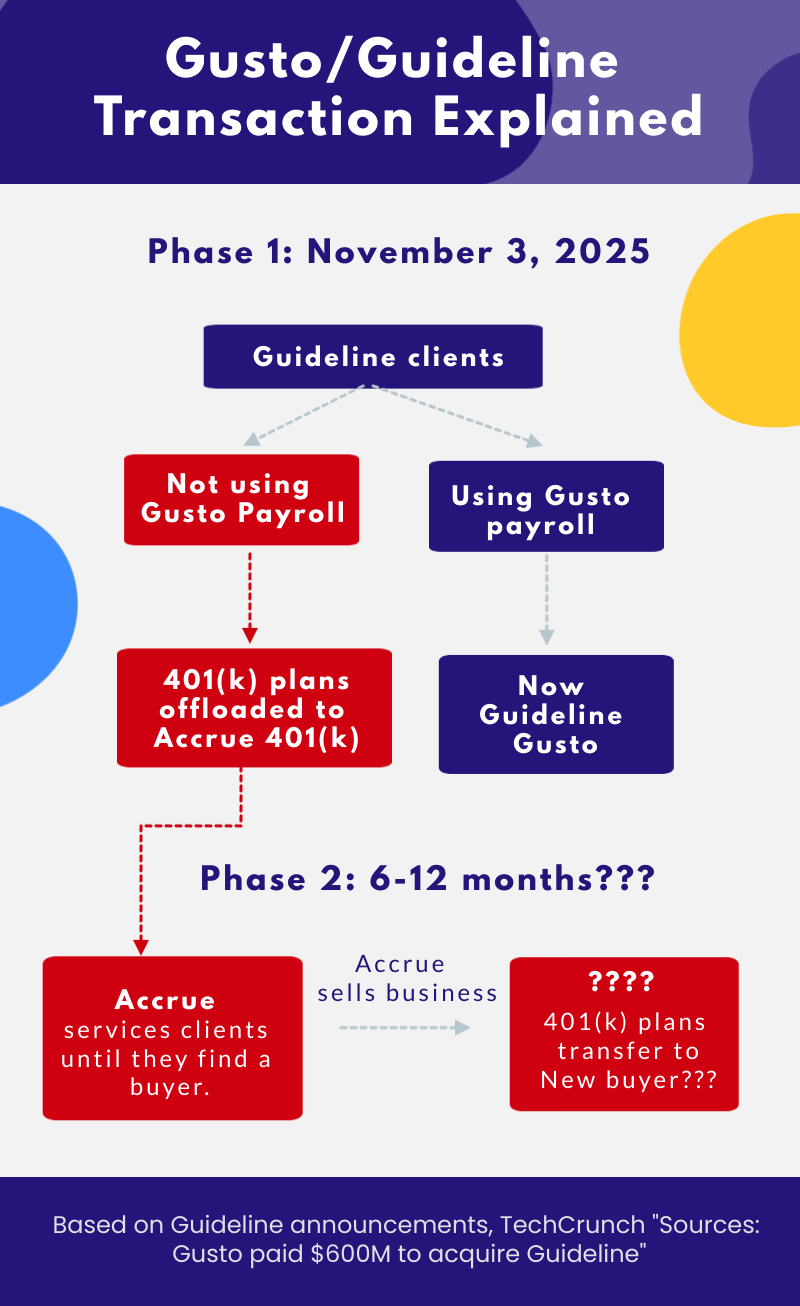
Phase 1: Guideline joins Gusto, leaving non-gusto plan sponsors behind
Gusto did not want to keep payroll links with other payroll companies for competition reasons.
To finalize the deal, Guideline/Gusto created a plan. They placed Guideline clients who did not use Gusto into a new 401(k) company - Accrue 401k. The Accrue 401(k) transition completed on November 3, 20225. Accrue will service former Guideline clients until they can sell these clients to a different 401(k) provider.
Phase 2: Accrue sells former Guideline clients to the highest bidder
People close to the deal say that Accrue will find new buyers for their plans, probably to the highest bidder. It appears that Accrue's mission is not to find the best home (or do what's best for employees) but to maximize returns on the sale.
What Guideline Has Said So Far
Guideline’s Help Center confirms the acquisition and offers regularly updated FAQs for employers, participants, and advisors.
Topics include:
- How the Gusto-Guideline payroll connection works
- The future of Guideline Pro (for advisors)
- Plan transition timelines and employer responsibilities
Beginning November 3, 2025, Guideline will stop opening new 401(k) accounts for employers not using Gusto payroll. Those existing plans will instead move to a newly created entity called Accrue 401(k).
What Is Accrue 401(k)?
Accrue 401(k) is an unaffiliated holding company established to handle Guideline’s non-Gusto 401(k) plans during this transition.
Here’s what we know:
- Accrue is not owned or managed by Gusto or Guideline
- Accrue was created to maintain temporary service continuity
- It has no public technology roadmap or long-term customer strategy
- Accrue is not registered with the SEC or FINRA. This means they cannot provide investment advice and are not held to the same fiduciary standards as Guideline.
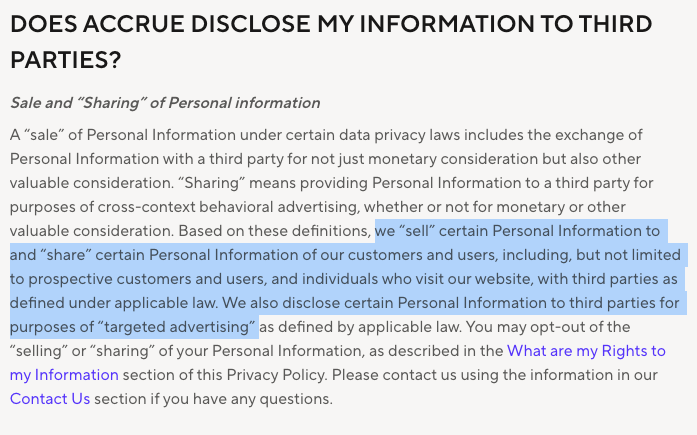
- Accrue sells & shares personal financial data to third parties (per their policy privacy statement)
Accrue said they will still offer Guideline's main features, but there are big issues. Accrue has no mobile app, few payroll connections, and a there is a chance of losing fiduciary protection, among other things.
Experts say that Accrue might sell these plans to whoever offers the most money. This could mean your plan would be managed by a different recordkeeper.
without your input.
Employers might have their retirement plans managed by a provider they did not choose.
But we still don't know a lot
First, if you have had a hard time doing your due diligence on Accrue - there's a reason... Their website just went live. We don't know the name of their CEO, how many employees they have, or how long the ultimate sale will take. Hopefully, Accrue will provide more information on their Get to know Accrue page.
Why the Guideline-to-Accrue Transition Matters
If your plan is being transferred to Accrue 401(k), consider the following potential implications:
1. Increased 401(k) costs
Plan costs are likely to go up, especially after Accrue ultimately sells your plan to the highest bidder.
New fees and higher costs for employers can hurt your company's money. They can also affect your workers' savings.
2. You may lose payroll integration
If you use a payroll provider that does not integrate with Accrue, you will need to upload and manage all payroll and census data by yourself. Unfortunately, as of now Accrue only lists 22 payroll integrations - meaning many plan sponsors will likely lose their integrations.
3. You may have lost your 3(38) investment fiduciary protection
If you did not consent to the assignment of your Investment Management, as of November 3rd, you lost fiduciary protection.
4. Your Fiduciary Responsibility Just Increased
According to the Department of Labor, “selecting competent service providers is one of the most important responsibilities of a plan sponsor.” You have a legal responsibility to evaluate Accrue and whichever 401(k) recordkeeper wins the bidding war for your employees retirement accounts.
In the meantime, you remain responsible for ensuring the plan is compliant, well-monitored, and cost-effective. Given all of the changes, you should keep an extra close plan on administration and compliance.
5. Potential Changes in Service Quality
Technology platforms, investment menus, and support teams may shift as ownership changes hands. In the meantime, be prepared for significant employee turnover with the teams that have been servicing your plan.
6. Accrue sells personal financial information
Accrue's privacy policy states that they "sell certain Personal Information... to third parties for purposes of 'targeted advertising'." This may create additional legal risk for plan sponsors (see the Shell and Vanderbilt cases) where plaintiffs alleged a misuse of plan data violated ERISA's fiduciary duty provisions (29 U.S. Code §1104) and prohibited transactions (29 U.S.C §1106(a)(1)).
7. Limited Window to Act
It may take Accrue 12 months or more to find a new provider, or it might be announced sooner. The exact timing is anyones guess. So you have a window to proactively choose your next recordkeeper before Accrue choses it for you. While that may seem like a long time, Accrue's deconversion may find themselves with a backlogged. Sponsors that wait, might find themselves in the back of a long line, waiting months for Accrue to help move your plan to their provider of choice.
Fiduciary Checklist for Plan Sponsors
A recordkeeper acquisition is one of the best times to re-evaluate your service provider. According to the DOL’s publication “Meeting Your Fiduciary Responsibilities,” plan sponsors should prudently select and monitor their providers — and document every step. In the case of Accrue's complicated two-phase transaction - that involves evaluating both Accrue and whichever recordkeeper Accrue ultimately sells your plan to.
Here’s a practical 401(k) fiduciary action plan:
Step 1: Assemble Key Plan Documents
Collect plan documents, fee disclosures, and historical service records. Documenting your review process protects you during audits.
Step 2: Benchmark Fees and Services
Compare recordkeepers across pricing, integrations, and support. PLANSPONSOR notes that many sponsors switch providers after M&A activity due to fee increases or service disruption.
Step 3: Confirm Payroll Integration
If you use a non-Gusto payroll provider, confirm future connectivity timelines in Guideline’s Help Center.
Step 4: Prepare for a Possible Recordkeeper Change
If you decide to move, expect a 60–90 day transition that includes:
- Data validation
- Participant blackout notices
- Asset transfer
- Post-conversion reconciliation
A pre-conversion “mini audit” helps catch data errors early.
Step 5: Communicate Clearly With Employees
Proactive updates about the transition prevent confusion and support fiduciary transparency.
Why Proactive Sponsors Have the Advantage
Waiting for Accrue 401(k) to change your plan means you lose control over costs, service quality, and following rules.
By acting now, you can:
- Keep your current payroll provider (no forced switch to Gusto)
- Select a recordkeeper aligned with your goals and workforce needs
- Lock in transparent fees and fiduciary support under your own terms
- Schedule your transition during a stable period rather than under external deadlines
How ForUsAll Supports Smooth 401(k) Transitions
At ForUsAll, we help plan sponsors navigate recordkeeper changes with confidence — whether you’re moving from Guideline, Accrue, or another provider.
We:
- Integrate with the payroll you already use (no need to switch systems)
- Handle ERISA compliance workflows so you stay audit-ready
- Provide a time-boxed, fully documented migration plan that minimizes disruption
Our focus is minimizing transition risk while maintaining compliance and fiduciary protection.
If you’re evaluating your next move, you don’t have to guess what’s best for your company.
Use our 401(k) Plan Comparison Tool to:
- Search for your current plan,
- See how your fees and services compare to Guideline 401k alternatives, and
- Get a transparent quote from ForUsAll in minutes.
Start your review today — and take control of your 401(k) plan before someone else does.
Sources & Further Reading
- Guideline Announcement: Guideline Enters Agreement to Be Acquired by Gusto
- TechCrunch: Gusto Paid ~$600M for Guideline; Plans to Divest Non-Gusto Customers
- Guideline Help Center: FAQs on the Gusto Acquisition
- Accrue 401(k) FAQ: Transition From Guideline to Accrue
- Department of Labor: Meeting Your Fiduciary Responsibilities
- PLANSPONSOR: Due Diligence During Recordkeeper Acquisitions
- PLANSPONSOR: Ensuring Clean Recordkeeper Conversions

